Latest Forecast
For the latest weather forecast visit www.yourweather.co.uk
The Climate
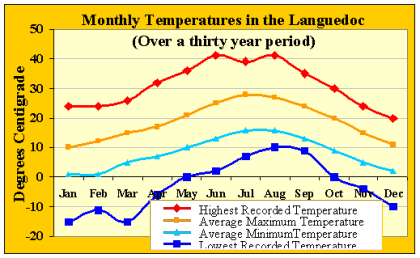
In general the Languedoc has hot dry summers, rainy winters, and moderate springs and autumns with 300 days of sunshine a year, but the region covers a large area, and for various reasons the weather can vary considerably within its borders.
The region is the hottest in France, with average annual temperatures between 13.5°C and 15°C. The coastline, sheltered by mountains, tends to be sunnier than and warmer than the inland areas. The mountains tend to be cooler, and valleys damper.
The coastal plains of the Languedoc rarely freeze in winter due to the influence of the Mediterranean Sea. Summer temperatures are frequently 30°C+. Generally, the inland temperatures are a few degrees cooler in winter and a few degrees warmer in summer.On the Languedoc plains the rainfall is about 28 inches a year although summer rain is infrequent and the days are long and dry. Heavy rains come in autumn and sometimes in spring.
Dry winds like the Mistral, and the Tramontane blow during the summer months. The Tramontane blows most frequently, and comes from the North-North-West of France. A few days each year the Scirocco (or Sirocco) blows, carrying a fine miasma of dust from the North African deserts.
- January and February are the winter months. Lots of rain, occasional frosts and snowfalls on the plains. Consistent
snow in the mountains.
- March and April are unpredictable, with glorious sunny interspersed with cloudy, rainy cool days.
- May and June are usually pleasant, with lots of sunshine and warm temperatures.
- July and August are hot and dry, with temperatures around 30° C. September can feel humid.
- October is often beautiful month. Days are warm and sunny.
- November and December are cooler but still very pleasant, with lots of sunshine.
 Monthly Sunshine
 Print
Print